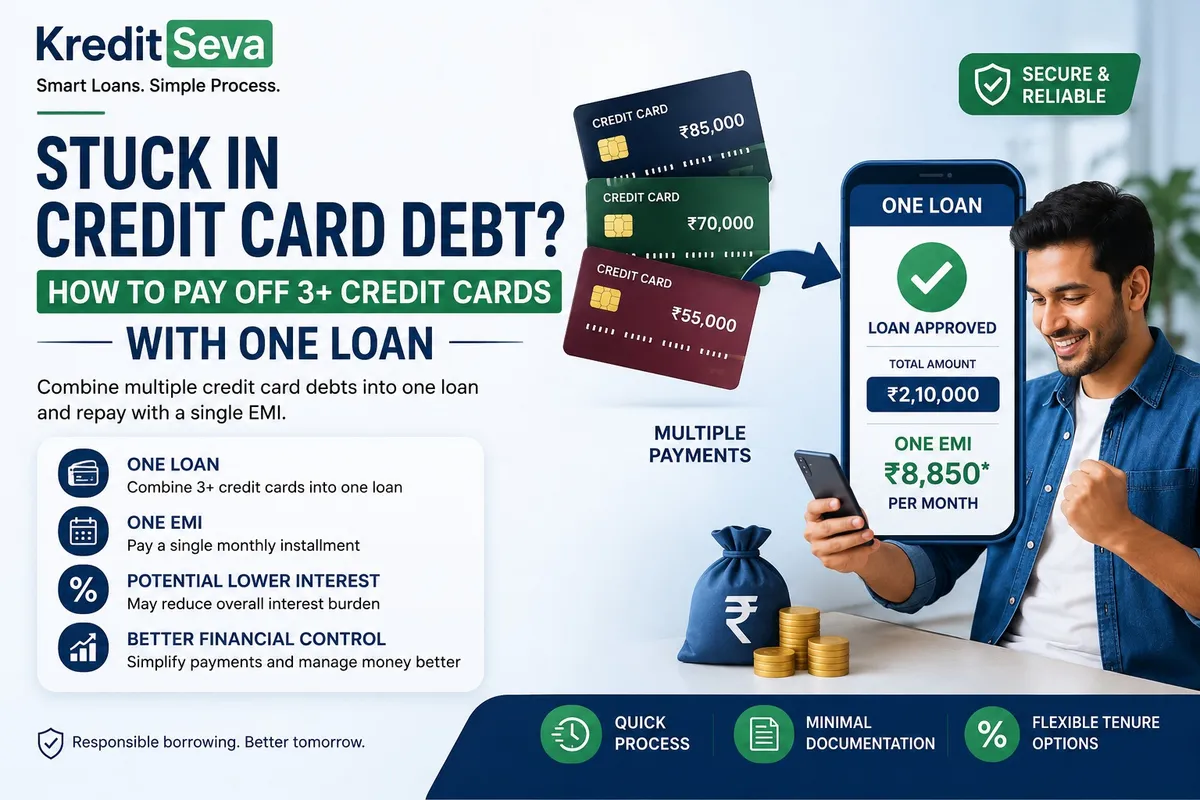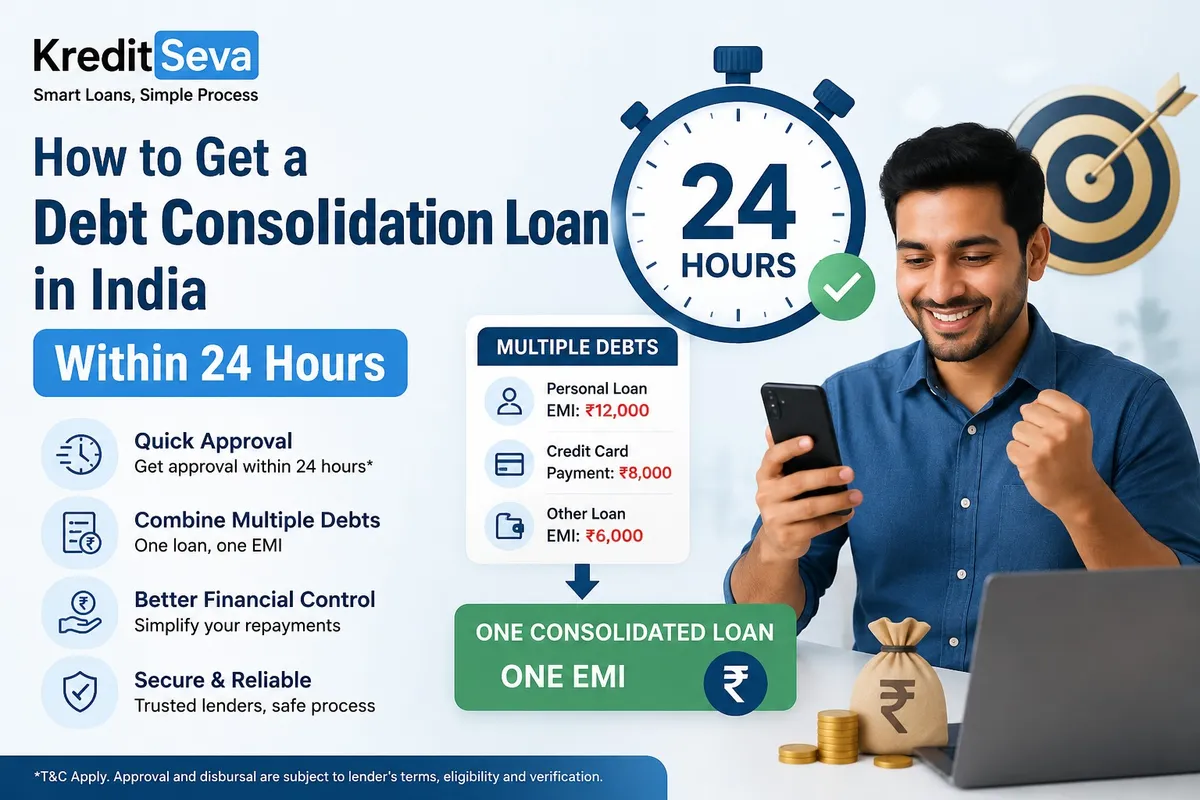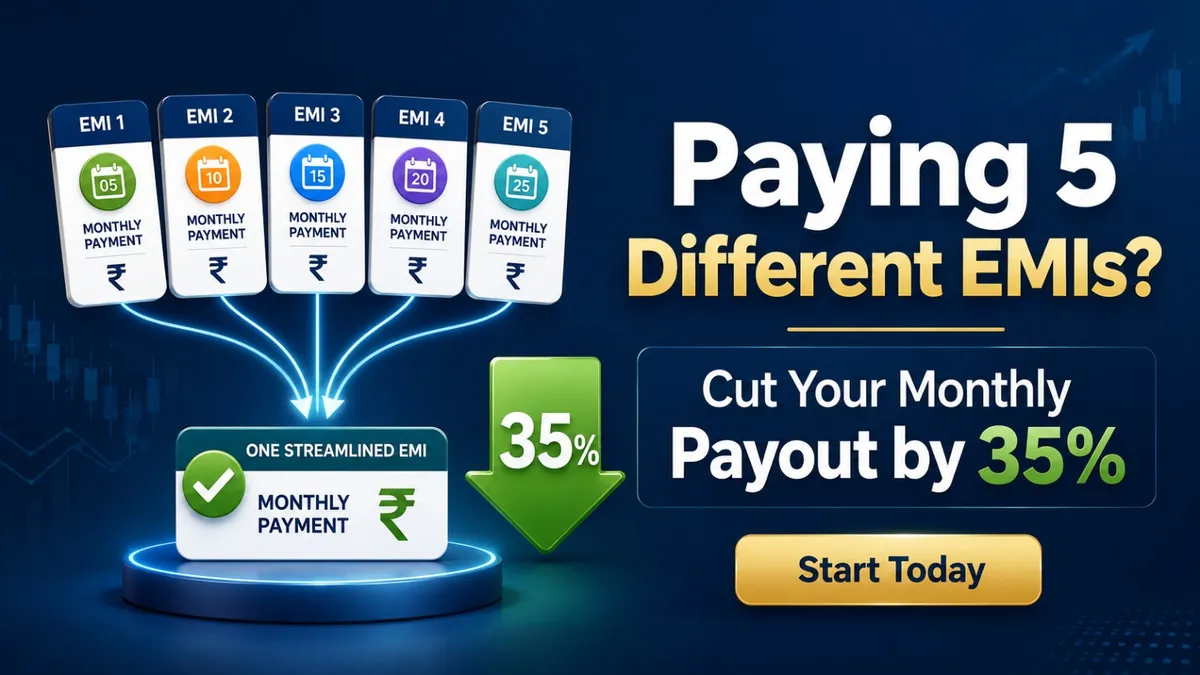
Managing several loan EMIs, credit card bills and other outstanding payments can become difficult, especially when every debt has a different interest rate and repayment date. A Loan to Consolidate Multiple Debts in India can help eligible borrowers combine various outstanding debts into a single loan. Instead of tracking multiple monthly payments, the borrower pays one consolidated EMI. This approach can simplify repayment planning, but it is important to understand its cost, eligibility conditions and potential risks before applying.
What Is a Debt Consolidation Loan?
A debt consolidation loan is a financing option used to repay multiple existing debts. The borrower takes a new loan and uses the funds to clear credit card balances, personal loans, medical bills or other eligible liabilities. After settling these accounts, only the new loan EMI remains.
A Loan to Consolidate Multiple Debts in India does not automatically reduce the total amount owed. Its primary purpose is to organise repayment and potentially replace expensive debts with a more manageable loan. The actual benefit depends on the new interest rate, processing charges, repayment tenure and the borrower’s financial discipline.
How Does Debt Consolidation Work?
The process begins by listing all outstanding debts, including their remaining balances, interest rates, EMIs and closure charges. The borrower then applies for a personal loan or another suitable consolidation facility equal to the total eligible outstanding amount.
Once approved, the loan amount is used to repay the selected liabilities. Some lenders may transfer the funds directly to the borrower, while others may settle the debts according to their policies. A Loan to Consolidate Multiple Debts in India can therefore convert several repayment obligations into one monthly instalment with a fixed due date.
Before proceeding, borrowers should obtain foreclosure statements from their existing lenders and calculate the total cost of closing the old loans.
Which Debts Can Be Consolidated?
Debt consolidation may be suitable for different types of unsecured financial obligations. However, eligible debts can vary according to the lender’s terms and credit policy.
Common debts that may be consolidated include:
- Credit card outstanding balances
- Multiple personal loans
- Consumer durable loans
- Medical expenses financed through credit
- Small unsecured business liabilities
- High-interest short-term loans
Secured debts, such as home loans or vehicle loans, may require a different refinancing or balance-transfer process. Borrowers should avoid using a high-cost unsecured loan to repay a comparatively low-interest secured loan without carefully comparing the total repayment amount.
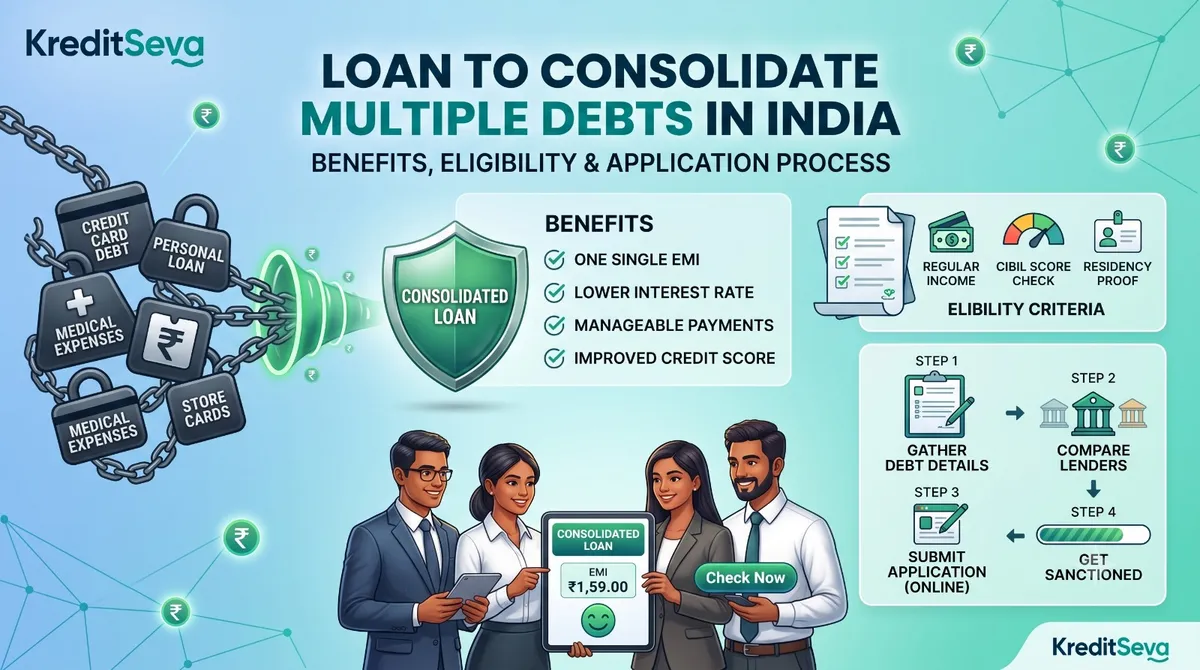
Major Benefits of Consolidating Multiple Debts
One EMI Instead of Multiple Payments
The most practical advantage is simplified financial management. Paying one EMI can be easier than remembering several repayment dates. It may also reduce the possibility of accidentally missing a payment.
Possibility of a Lower Interest Rate
Credit card balances and certain short-term loans can carry high interest costs. If a borrower qualifies for a lower rate, a Loan to Consolidate Multiple Debts in India may reduce the overall interest burden. However, this benefit only applies when the new loan’s total cost is lower after including all fees.
A Structured Repayment Schedule
Debt consolidation provides a defined loan tenure and EMI schedule. This can help borrowers create a monthly budget and understand when the consolidated debt is expected to be fully repaid.
Reduced Financial Stress
Keeping track of multiple creditors and due dates can be stressful. A single repayment plan may make financial obligations easier to understand and manage. It does not remove the debt, but it can bring greater clarity to the repayment process.
Potential Improvement in Credit Behaviour
Regular and timely payment of the new EMI may support a healthier credit profile over time. Nevertheless, loan approval does not guarantee an immediate improvement in the credit score. Credit utilisation, repayment history and new borrowing behaviour also influence the score.
Eligibility for a Debt Consolidation Loan
The eligibility requirements differ between banks, non-banking financial companies and digital lenders. Applicants are generally evaluated based on their income, employment stability, existing obligations and credit history.
A lender considering an application for a Loan to Consolidate Multiple Debts in India may check the following factors:
- Applicant’s age and residential status
- Monthly income and repayment capacity
- Employment or business stability
- Existing EMIs and debt-to-income ratio
- Credit score and repayment history
- Number of recent loan applications
- Total amount required for consolidation
- Bank account and income records
Salaried applicants may need to submit salary slips and employment details. Self-employed applicants may be asked for income tax returns, business proof and financial statements.
Documents Commonly Required
Applicants should keep their documents ready to make the application process smoother. The exact requirements depend on the lender and the applicant’s employment type.
Commonly requested documents include PAN card, Aadhaar card or another valid identity document, address proof, recent bank statements, salary slips, income tax returns and existing loan statements. Lenders may also request credit card statements, foreclosure letters or proof of the debts being consolidated.
Submitting accurate information is essential. Hiding an existing liability or providing incorrect income details can result in rejection and may create future financial complications.
Application Process
Step 1: Calculate Your Total Outstanding Debt
Prepare a detailed list of every loan and credit card balance. Include the interest rate, EMI, remaining tenure, foreclosure cost and late-payment amount, if applicable.
Step 2: Check Your Credit Profile
Review your credit report for incorrect accounts, duplicate entries or payment records. A stronger credit profile may help you qualify for more favourable loan terms.
Step 3: Compare Available Offers
Do not select a loan based only on a low advertised interest rate. Compare the annual interest rate, processing fee, insurance charge, foreclosure conditions, late-payment penalties and total repayment amount.
Step 4: Select a Suitable Tenure
A longer tenure may reduce the monthly EMI but can increase the total interest paid. A shorter tenure may save interest but result in a higher monthly obligation. The selected EMI should remain affordable after essential household expenses.
Step 5: Apply and Submit Documents
Complete the lender’s application form and provide the required documents. The lender will assess income, credit history and repayment capacity before approving or rejecting the application.
Step 6: Close the Existing Debts
After receiving a Loan to Consolidate Multiple Debts in India, use the funds only for the intended debt settlements. Collect closure certificates or no-dues letters and confirm that all cleared accounts are updated correctly in the credit report.
Important Factors to Consider Before Applying
Debt consolidation is beneficial only when it improves the borrower’s financial position. A smaller EMI does not always mean a cheaper loan. The EMI may decrease simply because the repayment tenure has been extended, which could result in paying more interest over time.
Borrowers should calculate the total amount payable under the new loan and compare it with the combined cost of continuing their existing repayments. Processing fees, GST, insurance charges and loan foreclosure penalties should be included in this calculation.
It is also important to stop creating new high-interest debt after consolidation. Continuing to use cleared credit cards excessively can leave the borrower with both a consolidation EMI and fresh credit card balances.
When Should You Consider Debt Consolidation?
A Loan to Consolidate Multiple Debts in India may be considered when a borrower has several high-interest debts, finds it difficult to manage multiple due dates and qualifies for a new loan with better overall terms. It may also help someone who has a stable income but needs a clearer repayment structure.
However, consolidation may not be suitable if the new interest rate is higher, the repayment tenure is excessively long or the applicant’s income is not sufficient for regular EMIs. Borrowers facing severe repayment difficulties should communicate with their lenders and consider seeking guidance from a qualified financial adviser.
How KreditSeva Can Help
KreditSeva provides information and assistance to help borrowers explore suitable debt-management and loan options based on their financial requirements. Applicants can use the platform to understand the process, review relevant eligibility factors and make a more informed borrowing decision.
Choosing a Loan to Consolidate Multiple Debts in India should always be based on repayment capacity and a transparent comparison of costs. Loan approval, interest rates and final terms remain subject to the lender’s eligibility assessment and internal policies.
Conclusion
Debt consolidation can simplify repayments by bringing several outstanding liabilities under one structured monthly payment. It may help reduce the complexity of managing multiple EMIs and could lower borrowing costs when better terms are available.
Before applying, calculate the total outstanding amount, compare loan offers and select an affordable tenure. A Loan to Consolidate Multiple Debts in India should be treated as a responsible repayment strategy rather than an opportunity to borrow additional money. With careful planning and timely EMI payments, borrowers can work towards becoming debt-free in a more organised manner.