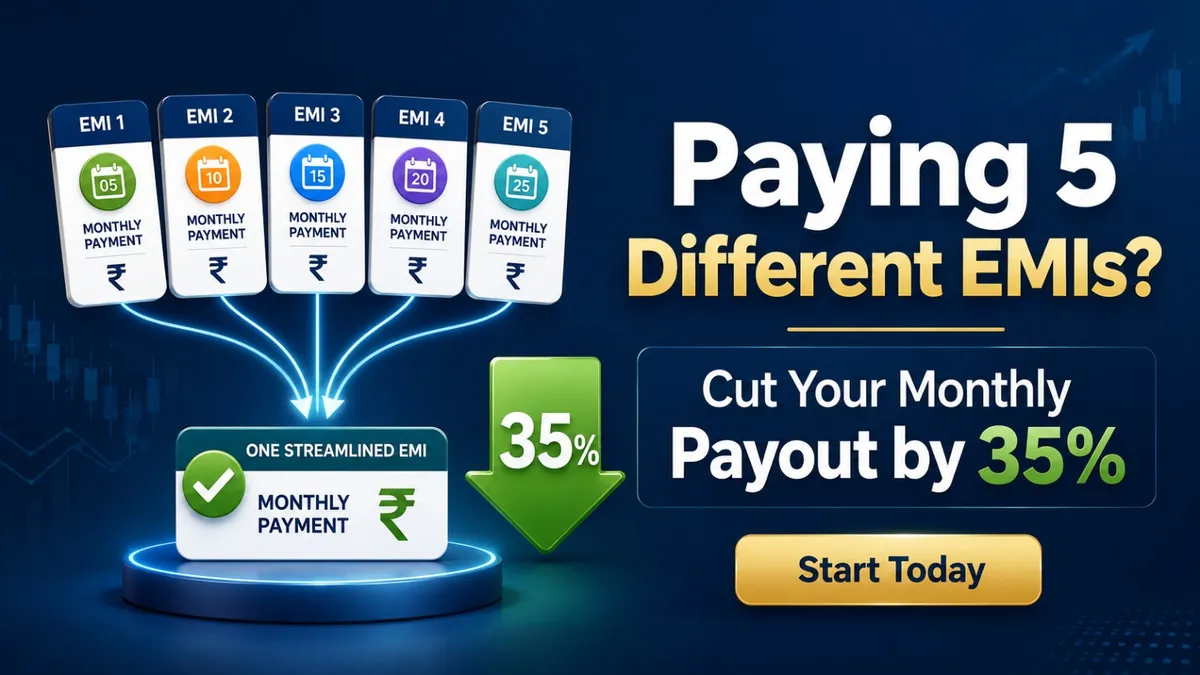
Paying five different EMIs every month can put serious pressure on your budget. A personal loan, credit-card balance, consumer loan, instant loan and vehicle loan may each appear manageable individually, but together they can consume a significant part of your monthly income.
One possible way to reduce this pressure is debt consolidation. It allows you to combine multiple loans into one structured loan with a single EMI. Depending on your current interest rates, outstanding balances and the tenure of the new loan, your monthly payout may reduce by up to 35%.
However, a 35% reduction is not guaranteed. A lower EMI can sometimes result from a longer repayment tenure, which may increase the total interest payable. Therefore, the objective should be to find a repayment plan that improves your monthly cash flow without making the loan unnecessarily expensive.
Quick Answer: How Can You Reduce Five EMIs into One?
You can combine five different EMIs into one by taking a debt-consolidation loan or using a balance-transfer facility with a top-up amount. The new loan is used to repay your existing debts. After all the selected loan accounts are closed, you only need to pay one EMI every month.
To reduce your monthly EMI burden effectively:
- Calculate the foreclosure amount of all existing loans.
- Identify loans carrying the highest interest rates.
- Check your credit score and monthly repayment capacity.
- Compare debt-consolidation offers from suitable lenders.
- Calculate the new EMI and total repayment amount.
- Use the approved amount to close your existing loans.
- Collect closure letters and start paying the new single EMI.
Why Do Five Different EMIs Become Difficult to Manage?
Multiple EMIs create more than a financial burden. They also make repayment tracking complicated because every lender may have a different due date, interest rate and penalty policy.
Borrowers managing several loans commonly face:
- Different EMI payment dates
- High credit-card interest
- Multiple auto-debit instructions
- Frequent payment reminders
- Increased risk of late-payment charges
- Limited money for household expenses
- Difficulty building emergency savings
Missing even one EMI can lead to late fees and may affect your credit history. Combining multiple EMIs into one EMI can simplify repayment and make monthly budgeting more predictable.
Can Debt Consolidation Reduce Your Monthly Payout by 35%?
Debt consolidation may reduce your monthly payout by up to 35% when the new loan provides a lower interest rate, a more suitable tenure or both.
Consider this example:
Suppose you currently pay the following EMIs:
- Personal loan: ₹14,000
- Credit-card EMI: ₹9,000
- Consumer loan: ₹5,000
- Instant loan: ₹8,000
- Second personal loan: ₹10,000
Your total monthly payout is ₹46,000.
If you consolidate these debts and receive a new single EMI of ₹30,000, your monthly payout will reduce by approximately 35%. This gives you an additional ₹16,000 of monthly cash flow.
However, you must compare the total repayment amount. If the new loan continues for a much longer period, you may pay more interest overall despite receiving a lower monthly EMI.
Step 1: Calculate the Outstanding Amount of Every Loan
Start by creating a complete list of your debts. Include personal loans, credit-card balances, buy-now-pay-later dues, consumer loans and app-based loans.
For every loan, record:
- Current outstanding balance
- Monthly EMI
- Interest rate
- Remaining tenure
- Foreclosure amount
- Prepayment charges
- Payment due date
Contact each lender and request an updated foreclosure statement. The total foreclosure value will help you understand how much money you need to consolidate five loans into one.
Do not rely only on the outstanding principal shown in your lender’s application. The final closure amount may include interest calculated up to the closure date and applicable foreclosure charges.
Step 2: Prioritise High-Interest Loans
Not every existing loan needs to be consolidated. A low-interest loan with only a few EMIs remaining may be better left unchanged, especially when its foreclosure charges are high.
Prioritise debts such as:
- Revolving credit-card balances
- High-interest instant loans
- Short-term loan-app borrowing
- Personal loans with expensive interest rates
- Loans carrying frequent late-payment charges
Replacing high-interest debt with a comparatively lower-rate consolidation loan can help reduce monthly loan payments and may also lower the overall borrowing cost.
Step 3: Check Your Eligibility for a Consolidation Loan
Lenders assess your credit and income profile before approving a loan to combine multiple EMIs.
They may evaluate:
- Credit score and repayment history
- Monthly salary or business income
- Employment stability
- Existing loan obligations
- Bank-account transactions
- Credit-card utilisation
- Recent loan enquiries
- Fixed-obligation-to-income ratio
A good repayment history and stable income may help you qualify for a better interest rate. Before applying, check your credit report for incorrect overdue amounts, duplicate accounts or loans that should already be marked as closed.
Avoid sending applications to several lenders simultaneously because multiple hard credit enquiries can negatively affect your credit profile.
Step 4: Compare Ways to Combine Multiple EMIs
There are different ways to convert five EMIs into one monthly payment.
Personal Debt-Consolidation Loan
A personal loan for debt consolidation can be used to repay multiple unsecured debts. It generally does not require collateral, but the offered interest rate depends on your income, credit history and existing obligations.
Balance Transfer with a Top-Up Loan
You may transfer an existing personal loan to a lender offering more suitable terms. If you qualify for an additional top-up amount, you may use it to close other outstanding loans.
Secured Consolidation Loan
A loan against property, fixed deposit or another eligible asset may offer a lower interest rate. However, the asset is used as security. Failure to repay the loan can put the asset at risk, so consider this option carefully.
Step 5: Compare the EMI and Total Repayment Cost
A lower EMI does not always mean a cheaper loan. It may simply mean that the repayment period has been extended.
Before accepting an offer, compare:
- New interest rate
- New monthly EMI
- Repayment tenure
- Processing fee
- Insurance charges
- Foreclosure charges on old loans
- Total interest payable
- Total repayment amount
For example, reducing your monthly payout from ₹46,000 to ₹30,000 can improve your immediate budget. But if the new loan continues for several additional years, the total interest may increase significantly.
Choose the new loan only if the monthly relief and overall cost are reasonable for your financial situation.
Step 6: Close Your Existing Loans Properly
Once the debt-consolidation loan is approved, use the money specifically to repay the selected debts. Avoid spending any part of the amount on shopping, travel or other non-essential expenses.
After repayment:
- Confirm that every selected loan has a zero balance.
- Collect a no-dues certificate from each lender.
- Obtain loan-closure letters.
- Cancel unnecessary auto-debit instructions.
- Check for residual interest or hidden charges.
- Keep all payment receipts and closure documents.
After the lenders update their records, review your credit report to confirm that the old accounts are shown as “closed” rather than “settled.” A settled status may negatively affect future loan eligibility.
Step 7: Prevent New Debt After Consolidation
Debt consolidation works only when you avoid creating additional debt. If you start using the cleared credit limits again, you may end up paying the new consolidation EMI along with fresh credit-card bills.
Create a monthly budget, maintain an emergency fund and schedule auto-debit for your new EMI. Whenever possible, make part-prepayments after checking whether the lender charges a prepayment fee.
Kreditseva can help borrowers understand suitable ways to organise multiple loan repayments. However, loan approval, interest rates and EMI reductions depend on the lender’s assessment and the borrower’s financial profile.
Is Combining Five EMIs into One a Good Decision?
Combining multiple loans into one EMI may be beneficial if it:
- Reduces your monthly repayment burden
- Replaces expensive debt with a lower interest rate
- Simplifies payment tracking
- Reduces the possibility of missed EMIs
- Provides a clear debt-free timeline
- Improves your monthly cash flow
It may not be suitable if the new loan has high processing charges, an excessively long tenure or a higher total repayment amount.
Final Thoughts
If you are paying five different EMIs, debt consolidation can provide a simpler and more manageable repayment structure. A well-planned consolidation loan may reduce your monthly payout by up to 35%, but the exact saving will depend on your interest rate, tenure, outstanding debt and eligibility.
Before applying, calculate every foreclosure amount, compare multiple suitable offers and review the total cost—not only the advertised EMI. Once your old debts are closed, avoid fresh borrowing and pay the new single EMI on time.
The purpose of debt consolidation should be to create a realistic path towards becoming debt-free, not merely to postpone repayment.
Frequently Asked Questions
1. How can I combine five different EMIs into one EMI?
You can apply for a debt-consolidation loan or an eligible balance transfer with a top-up facility. The approved amount is used to close your existing debts, after which you repay only one monthly EMI.
2. Can I really reduce my monthly EMI by 35%?
A reduction of up to 35% may be possible depending on your current EMIs, outstanding balance, new interest rate and repayment tenure. It is not guaranteed, and a longer tenure may increase the total interest payable.
3. Will debt consolidation improve my CIBIL score?
Debt consolidation does not automatically improve your CIBIL score. However, closing existing debts and consistently paying the new EMI on time may support your credit profile over time.