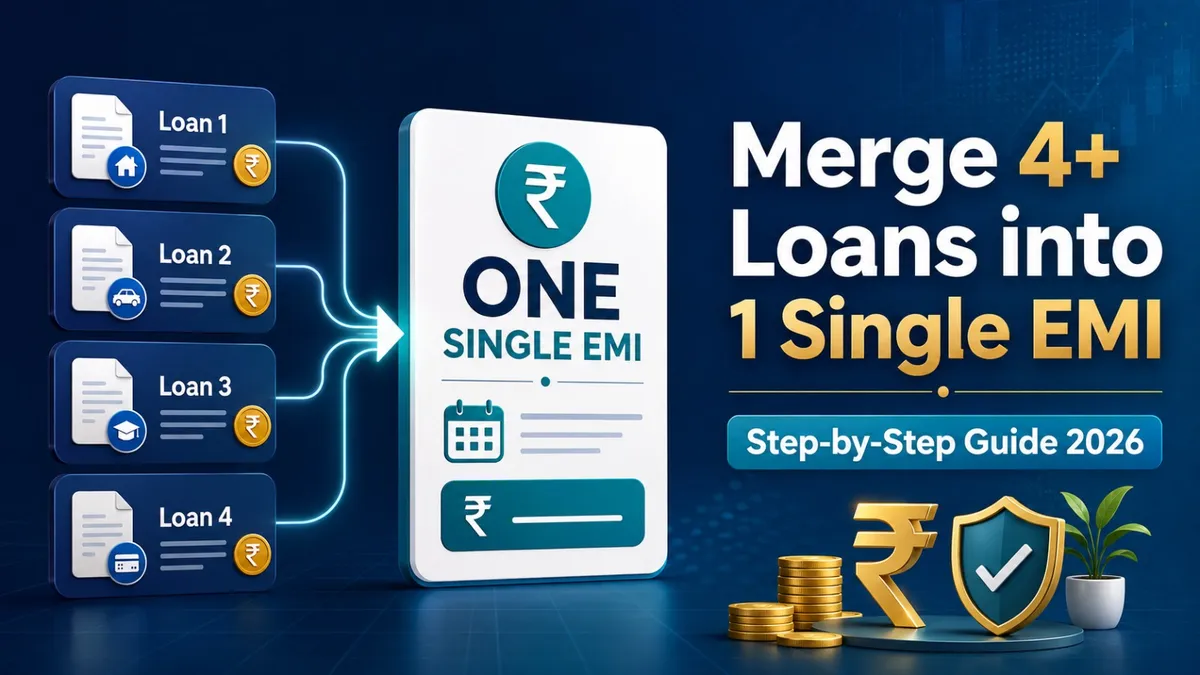
Managing four or more loans can become stressful. Different EMI dates, interest rates, lenders, and repayment periods make it easy to miss a payment. Even when you earn enough to pay every EMI, handling several debts separately may disturb your monthly budget. One possible solution is to merge multiple loans into one EMI through debt consolidation.
This guide explains how to combine multiple loans into one loan, the steps involved, eligibility requirements, benefits, risks, and important checks to complete before applying in 2026.
What Does Merging Multiple Loans into One EMI Mean?
Merging loans means taking a new consolidation loan to repay several existing debts. Once the old accounts are closed, you repay only the new loan through a single monthly instalment.
For example, suppose you have two personal loans, one credit-card balance, and one consumer-durable loan. Instead of paying four separate EMIs, you may obtain a single personal loan or debt-consolidation loan and use it to clear all four outstanding balances. You will then have one loan and one EMI to manage.
Debt consolidation does not erase your debt. It reorganises your borrowings into a simpler repayment structure. Whether it saves money depends on the new interest rate, fees, and tenure.
Step 1: List All Your Loans and Outstanding Amounts
Prepare a complete debt list. Include personal loans, credit-card dues, app-based loans, consumer loans, and other unsecured borrowing. For every account, note:
-
Outstanding principal
-
Current interest rate
-
Monthly EMI or minimum payment
-
Remaining tenure
-
Foreclosure or prepayment charge
-
Payment due date
Add the foreclosure amounts to estimate how much money you need to consolidate multiple loans into one EMI. Ask each lender for an updated foreclosure statement because the amount shown in an app may not include all charges.
Step 2: Check Your Credit Profile and Repayment Capacity
Before applying, review your credit report and score. Lenders generally examine repayment history, current obligations, credit utilisation, income stability, and recent loan enquiries. Missed payments or excessive applications can reduce your approval chances.
Calculate your total monthly EMI and compare it with your net monthly income. A lender will assess whether the proposed single EMI is affordable. A good credit profile and stable income may help you secure a lower interest rate when you combine four loans into one.
Step 3: Compare Consolidation Options
Common options for merging loans include:
Personal Loan for Debt Consolidation
An unsecured personal loan can be used to close several high-interest debts. It may be suitable when you have a strong credit score and need a straightforward multiple-loan consolidation option.
Balance Transfer with a Top-Up Loan
If you already have a personal loan with a good repayment record, another lender may offer a balance transfer plus a top-up amount. The top-up can sometimes be used to repay additional debts.
Secured Loan
A loan against property, fixed deposit, or another eligible asset may offer a lower rate. However, the asset becomes security, so default can put it at risk. Avoid converting unsecured debt into secured debt without understanding this consequence.
Compare the annual interest rate, processing fee, insurance, foreclosure charges, total interest payable, and final repayment amount—not just the EMI.
Step 4: Calculate the Real Cost of the New Single EMI
A lower EMI does not automatically mean a cheaper loan. The EMI may fall simply because the repayment tenure is longer, which can increase total interest.
For example, your current combined EMIs may be ₹32,000 for 24 months. A new lender might offer a single EMI of ₹20,000 for 48 months. The monthly burden is lower, but the overall repayment could be higher. Use an EMI calculator and compare:
-
Total amount payable on existing loans
-
Foreclosure charges for old loans
-
Processing and other fees on the new loan
-
Total amount payable under the consolidation loan
Proceed only when the new structure improves affordability or produces a clear financial benefit.
Step 5: Apply with the Required Documents
After selecting a suitable lender, submit the application. Requirements vary, but lenders commonly ask for identity and address proof, PAN, salary slips or income proof, bank statements, employment or business details, and statements of existing loans.
Avoid applying to many lenders simultaneously. Multiple hard enquiries within a short period can affect your credit profile. Shortlist suitable offers before submitting a formal application to merge all loans into one monthly payment.
Step 6: Use the Funds to Close Existing Loans
Once the consolidation loan is approved and disbursed, use the funds for their intended purpose. Some lenders may pay your existing lenders directly; others may credit the amount to your bank account.
Repay every selected loan completely. Collect a no-dues certificate or closure letter from each lender. For credit cards, confirm whether you want to close the card or keep it open with a zero balance. Do not assume an account is closed merely because payment has been made.
Step 7: Verify Closure and Start the New Repayment Plan
Check your old loan accounts after payment and ensure no residual interest or fee remains. Review your credit report after the lenders have had time to update it. If an account is incorrectly shown as active or overdue, raise a dispute with supporting closure documents.
Set an auto-debit instruction for your new single EMI and maintain a sufficient balance before the due date. Create a small emergency fund so an unexpected expense does not cause another cycle of borrowing.
Benefits of Combining Multiple Loans into One
The main advantages may include:
-
One EMI and one payment date
-
Easier budgeting and repayment tracking
-
Potentially lower interest than costly credit-card or instant-loan debt
-
Reduced risk of accidentally missing an EMI
-
A repayment tenure aligned with your cash flow
These benefits depend on receiving suitable terms and using the new loan responsibly.
Risks and Mistakes to Avoid
Do not choose a loan only because it offers a smaller EMI. Check the total cost and avoid an unnecessarily long tenure. Do not take extra funds unless required, and do not start using cleared credit limits for fresh spending. Otherwise, you could end up paying the consolidation EMI alongside new debt.
Also verify the lender's legitimacy, read the sanction letter carefully, and never pay an unofficial agent promising guaranteed approval. Kreditseva can help borrowers understand debt-consolidation choices, but approval and loan terms ultimately depend on the lender's eligibility rules and assessment.
Conclusion
To merge 4+ loans into one single EMI, begin by listing every debt, checking foreclosure amounts, reviewing your credit profile, and comparing consolidation options. Calculate the complete cost before applying, close all selected loans after disbursal, and preserve the closure documents.
A single EMI can simplify your finances and reduce monthly pressure, but it works best when the new interest rate, charges, and tenure genuinely suit your repayment capacity. The goal should be to become debt-free in a structured way—not merely to shift debt from several accounts into one.
Frequently Asked Questions
1. Can I merge four or more loans into one EMI?
Yes, subject to lender approval and your eligibility. You may use a personal consolidation loan, balance transfer with top-up, or an appropriate secured loan to repay multiple existing debts and create one EMI.
2. Will loan consolidation improve my CIBIL score?
It may support your credit profile over time if you close outstanding debts and consistently pay the new EMI on time. However, the application may initially create a hard enquiry, and consolidation does not guarantee a higher score.
3. Is it good to combine multiple loans into one loan?
It can be useful when it lowers borrowing costs, simplifies repayment, or makes the monthly obligation manageable. It may not be beneficial if high fees or a longer tenure significantly increase the total repayment.